

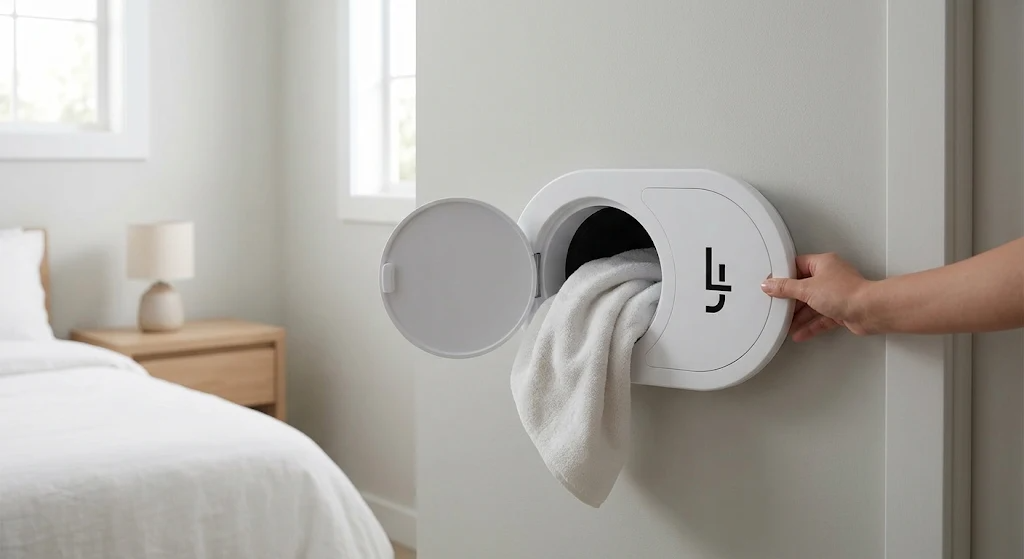
Laundry is part of everyday life, but carrying clothes, towels, and bedding from different rooms to the laundry area can become a repetitive chore. In larger homes, especially those with multiple floors, moving laundry baskets up and down stairs can make the process even less convenient.
A laundry chute offers a practical way to simplify this routine. Traditional laundry chutes use gravity to move dirty clothes from an upper floor to a collection area below. Modern vacuum-powered laundry chute systems, however, use airflow to transport clothes through a concealed pipe network, allowing greater flexibility in how a home is designed.
Whether you’re building a new house, renovating an existing property, or exploring a more convenient laundry setup, understanding what a laundry chute is, how it works, and which system suits your home can help you make an informed decision.
At Laundry Jet, modern air-powered laundry chute systems are designed to move clothing from convenient access points around the home directly to the laundry room, without relying on gravity alone.
Table of Contents
1. What Is a Laundry Chute?
2. How Does a Laundry Chute Work?
3. What Are the Different Types of Laundry Chutes?
4. What Are the Main Uses of a Laundry Chute?
5. What Are the Benefits of a Modern Laundry Chute?
6. Where Can You Install a Laundry Chute in Your Home?
7. Can Laundry Chutes Work in Single-Story and Multi-Story Homes?
8. What Should You Know About Laundry Chute Installation?
9. What Size Should a Laundry Chute Be?
10. Are Laundry Chutes Safe and Easy to Maintain?
11. How Do Laundry Jet Systems and Ports Work?
12. Can a Laundry Chute Return Clean Clothes?
13. How Much Does a Laundry Chute System Cost?
14. How Do You Choose the Right Laundry Chute System?
15. Frequently Asked Questions
16. Final Thoughts
1. What Is a Laundry Chute?
A laundry chute is a system designed to transport clothing and other laundry items from one location in a building to a designated laundry collection area.
In a traditional home, a laundry chute usually consists of a vertical passage or enclosed duct. Dirty clothes are placed into an opening on an upper floor and fall into a basket, hamper, or laundry area below.
The purpose is simple: reduce the need to carry laundry manually between different parts of the property.
Today, the term laundry chute system can describe more than a traditional gravity-fed passage. Newer systems use powered airflow to transport laundry horizontally, vertically, and around changes in direction.
For example, a modern vacuum-powered laundry chute system can move clothes from a bedroom, closet, or hallway to a laundry room through connected pipes, even when both rooms are on the same floor. This makes the technology suitable for a wider variety of residential layouts.
2. How Does a Laundry Chute Work?
The way a laundry chute works depends on whether it is a traditional gravity chute or a modern powered system.
How Does a Traditional Gravity Laundry Chute Work?
A conventional gravity laundry chute operates without a motor or powered airflow. When someone places clothing into the chute opening, gravity pulls the items downward through the passage until they reach a collection point.
A typical setup includes:
- An opening or chute door on an upper floor
- A vertical, enclosed passage
- A receiving basket or collection area
- A lower-level laundry room or storage space
Because the system relies on gravity, the collection area normally needs to be below the point where the laundry enters. This limits the possible layout, particularly in single-story homes or properties where the laundry room is not directly below the bedrooms.
How Does a Vacuum-Powered Laundry Chute Work?
A vacuum laundry chute, also called an air-powered laundry chute, uses controlled airflow instead of depending entirely on gravity.
In the Laundry Jet system, a motor-driven vacuum unit generates airflow through connected pipes. When a compatible laundry port is activated, clothing is drawn into the pipe and transported toward the receiving unit in the laundry room.
The process generally follows these steps:
- Open or activate the laundry port. The system begins its operating cycle.
- Insert the dirty laundry. Clothing, towels, or bedding are fed through the port.
- Airflow transports the items. The laundry moves through the connected pipe network.
- The receiving unit collects the laundry. Items arrive in the laundry room.
- The cycle finishes. The system switches off and becomes ready for the next use.
Unlike a gravity chute, a powered laundry chute can transport clothing through routes that include horizontal sections and changes in direction. This flexibility makes it possible to create a convenient laundry chute system for a home with different floor plans.
Explore how Laundry Jet works to see how vacuum-powered laundry transport can fit into a modern home.
3. What Are the Different Types of Laundry Chutes?
There are several approaches to laundry transport, but the two main categories are traditional gravity-fed chutes and powered laundry chute systems.
Traditional Gravity Laundry Chutes
A traditional laundry chute is often found in older multi-story homes or incorporated into new construction. These systems typically have a straightforward vertical design and do not require a motor to move clothing downward.
They may suit homes where the laundry room sits directly below the collection point. However, they offer limited flexibility when rooms are separated horizontally.
Vacuum-Powered Laundry Chutes
A vacuum-powered laundry chute uses airflow to transport clothing through a planned network of pipes. This type of system can be suitable for:
- Single-story and multi-story homes
- Houses with basement laundry rooms
- Bedrooms located far from the laundry area
- Properties with several collection points
- New residential construction and certain renovations
A laundry vacuum system can be especially useful when homeowners want convenient laundry access without placing the washer and dryer near every bedroom.
Laundry Chute Kits and DIY Chutes
A laundry chute kit generally refers to components used to build a conventional gravity-fed chute. Some homeowners explore DIY options to create a simple passage between floors. However, a traditional laundry chute kit is not the same as a purpose-built vacuum-powered laundry chute system.
Powered systems involve additional equipment, pipe routing, electrical connections, compatible ports, and manufacturer-specific installation requirements. Anyone comparing a DIY laundry chute with a powered system should consider the intended route, installation complexity, maintenance access, and suitability for the property.
4. What Are the Main Uses of a Laundry Chute?
The main purpose of a laundry chute is to make everyday laundry collection easier. Different households and properties may benefit from the system in different ways.
Collecting Dirty Clothes from Bedrooms
Bedrooms are common locations for laundry access points because much of the household’s dirty clothing accumulates there. A conveniently positioned port allows family members to send clothing toward the laundry room without leaving baskets of dirty clothes in every bedroom.
Transporting Towels and Bedding
Laundry chute systems can also help manage towels, sheets, and suitable bedding. Homeowners may want a laundry access point near a bathroom, bedroom, or linen storage area. Laundry Jet’s powered systems are designed to handle a range of clothing and household linens, subject to the selected model’s specifications.
Making Laundry Easier in Multi-Level Homes
In a home where the laundry room is located in the basement or on another floor, carrying full baskets can become inconvenient. A home laundry chute provides another way to move laundry between these areas.
Supporting Larger Households
For families managing frequent laundry loads, having several convenient access points can help keep dirty clothing moving toward a central laundry area. Rather than waiting for baskets to fill up in different rooms, smaller amounts of laundry can be collected throughout the day.
Commercial Laundry Transport
Certain commercial laundry chute systems are designed for environments where large volumes of towels, linens, clothing, or other suitable items must be transported. Potential applications include hotels, spas, gyms, salons, and other facilities that regularly handle laundry. Commercial requirements differ from typical residential installations, so equipment and layout must be assessed for the intended application.
5. What Are the Benefits of a Modern Laundry Chute?
A well-designed laundry chute system can offer several practical benefits, particularly when the system matches the home’s layout and household routine.
Less Manual Laundry Carrying
One of the most noticeable benefits is reducing the need to move baskets of dirty clothing from room to room. Instead of carrying laundry to a separate collection point, homeowners can use a nearby chute opening.
A More Organized Living Space
Laundry baskets in bedrooms, hallways, and closets can take up valuable floor space. A convenient laundry chute encourages household members to send dirty clothing toward the designated laundry area, potentially reducing the number of baskets needed around the home.
Greater Layout Flexibility
Traditional chutes generally need a downward route. A vacuum laundry chute system can follow a more flexible planned pipe route, making powered systems useful in properties where a conventional gravity chute would be difficult to incorporate.
Convenience for Single-Story Homes
A major advantage of an air-powered laundry chute is that it does not need a higher floor to work. This gives single-story homeowners the option to move laundry from bedrooms or other areas toward a laundry room on the same level.
Multiple Laundry Collection Points
Depending on the selected model, a powered system can connect several laundry ports to one receiving unit. This can be useful in homes with multiple bedrooms, bathrooms, or changing areas.
Options for Returning Clean Laundry
Some powered laundry systems can also be configured to transport clean clothing back toward a chosen room. This creates additional convenience after the washing and drying process.
Modern Home Integration
A modern laundry chute can be incorporated into closets, bedrooms, and other suitable locations without requiring a traditional visible vertical shaft. The final appearance depends on the port design, pipe routing, available space, and installation plan.
6. Where Can You Install a Laundry Chute in Your Home?
Choosing the location of a laundry chute in a house is one of the most important parts of planning. A useful laundry access point should be convenient for everyday use while allowing an appropriate route to the receiving unit.
Bedroom Laundry Chutes
A bedroom port provides a convenient way to send worn clothing directly toward the laundry room. This can be helpful in family homes where each bedroom is located some distance from the laundry area.
Closet Laundry Chutes
A closet laundry chute can provide a discreet collection point near wardrobes and dressing areas. Closets may also offer suitable space for concealing pipe routes, depending on the home’s construction.
Bathroom Laundry Chutes
A bathroom laundry chute may be useful for towels and clothing collected during daily routines. Placement must allow safe access and remain compatible with the selected port and surrounding conditions.
Hallway Laundry Chutes
A hallway port may serve multiple rooms from one accessible location. Rather than installing a separate port in every bedroom, a homeowner might choose a shared point near the bedrooms.
Laundry Room and Basement Connections
The receiving unit is normally positioned in or near the laundry area. Whether the laundry room is on the ground floor, in a basement, or elsewhere, the system must be planned around the available pipe route and model requirements.
Before choosing a location, review the available Laundry Jet installation guides and videos.
7. Can Laundry Chutes Work in Single-Story and Multi-Story Homes?
Yes, but the type of system matters.
Laundry Chutes in Single-Story Homes
Traditional gravity chutes depend on a change in elevation, so they are generally unsuitable for moving laundry between rooms on the same floor. A vacuum-powered laundry chute works differently: airflow can move clothes along a properly designed horizontal route.
This makes a powered chute an option for a one-story home where bedrooms and the laundry room are separated by hallways or other living spaces.
Laundry Chutes in Two-Story Homes
A two-story home may accommodate either a gravity-fed chute or a powered system. A conventional chute requires a suitable downward passage. A powered laundry chute system for the home can offer more flexibility when the receiving unit is not directly below the collection point.
Laundry Chutes in Larger Multi-Level Homes
Larger homes may require several access points and longer pipe routes. The selected system must provide sufficient capacity and performance for the proposed configuration. Laundry Jet offers different residential models to accommodate varying numbers of ports and installation requirements.
8. What Should You Know About Laundry Chute Installation?
Laundry chute installation should begin with a review of the home’s layout, collection points, receiving-unit location, and available routes for the pipe network. Planning is particularly important for a powered system because the equipment must work as a connected installation.
Installing a Laundry Chute in a New Home
New construction provides an opportunity to incorporate laundry transport into architectural and mechanical plans. Homeowners and builders can consider:
- Preferred laundry port locations
- The location of the laundry room
- Concealed pipe routes and service access
- Electrical and control-cable requirements
- Space for the receiving unit
- Future maintenance access
Planning these details early may make it easier to integrate the system into the home’s design.
Can You Install a Laundry Chute in an Existing Home?
In many cases, a laundry chute can be installed in an existing house, but feasibility depends on the building. For a Laundry Jet installation, pipe routes may pass through suitable closet spaces, attics, crawl spaces, or purpose-built chases.
Existing framing, structural elements, utilities, available clearances, and the location of the laundry room all need to be considered. A site-specific assessment is important before assuming a particular route will work.
How to Plan a Powered Laundry Chute Installation
A typical Laundry Jet project involves planning and installing the pipe network, positioning the receiving unit, connecting the ports, and testing the complete system. The exact process varies by model.
For technical details, component requirements, and model-specific instructions, visit Laundry Jet Installation Information.
9. What Size Should a Laundry Chute Be?
Laundry chute dimensions depend on the type of system, the intended laundry items, and the manufacturer’s requirements. A traditional gravity chute and a modern vacuum laundry chute do not necessarily use the same dimensions or installation methods.
Traditional Laundry Chute Dimensions
For a gravity-fed chute, the passage must be wide enough to allow suitable clothing and linens to fall without frequently catching on the sides. The appropriate dimensions depend on the design, material, route, local building requirements, and intended use. No single dimension should automatically be used for every home.
Laundry Jet Pipe Size
Laundry Jet’s residential installation guidance specifies 6-inch SDR35 solvent-weld PVC pipe and compatible fittings for its laundry transport network. The outside diameter and required installation clearance must also be considered, especially when fitting pipe routes around existing walls or framing.
This is why planning the route is just as important as choosing where to position a laundry port. Always confirm pipe specifications for the exact model and revision of its installation guide.
Why Do Pipe Layout and Port Placement Matter?
Even with the correct pipe size, the installation depends on the complete route. Changes in direction, pipe length, access points, available space, and model specifications can affect the design. Homeowners should use the applicable manufacturer’s installation instructions rather than a generic DIY laundry chute guide.
10. Are Laundry Chutes Safe and Easy to Maintain?
Like any built-in home system, a laundry chute should be correctly designed, installed, operated, and maintained.
Safe Port Placement
Laundry ports should be positioned where they are convenient for intended users while reducing the likelihood of misuse. Households with young children may prefer locations or heights that make ports less accessible without supervision.
Use the System Only for Suitable Laundry
Powered laundry chutes are designed for appropriate clothing and linens, not for toys, hard objects, sharp items, or unrelated household materials. Items should be introduced according to the manufacturer’s operating instructions.
Keep the Pipe Network Accessible
A well-planned installation should consider future cleaning and maintenance. Accessible cleanouts and appropriate routing can help with inspection and troubleshooting when necessary.
Consider Local Building Requirements
Laundry chute installation may involve building, fire-safety, electrical, and other local requirements. These rules vary by jurisdiction and building type. Homeowners in the United States should check applicable local requirements and use qualified professionals where necessary.
What About Noise and Energy Use?
A powered laundry chute uses electricity during operation, unlike a gravity-only chute. Noise near the motor or receiving unit depends on the model, installation location, and venting arrangement. Operating cycles are intermittent rather than requiring the system to run continuously throughout the day.
For more operating and maintenance information, visit the Laundry Jet FAQs.
11. How Do Laundry Jet Systems and Ports Work?
Laundry Jet offers a modern vacuum-powered laundry chute system designed around connected laundry ports, a concealed pipe network, and a receiving unit. The current residential Vuelo range includes three models intended for different household requirements.
Laundry Jet Express Vuelo
The Laundry Jet Express Vuelo is the entry-level model, designed for smaller configurations with up to two port locations. It supports compatible low-voltage manual ports and offers an automated transport cycle.
Laundry Jet Swift Vuelo
The Laundry Jet Swift Vuelo is a mid-range, wall-mounted system designed for configurations with up to four ports. It supports compatible manual and automatic port options and may suit households requiring additional collection points.
Laundry Jet Plus Vuelo
The Laundry Jet Plus Vuelo is the higher-capacity residential model. It supports up to eight port locations and is designed for integration into custom cabinetry, making it an option for larger or more complex home layouts.
Manual and Automatic Laundry Ports
A laundry chute port is the access point where clothing enters the system. Different Laundry Jet port options include:
- Lift Port — a manual lift-to-open port.
- Slide Port — a manual sliding port.
- iTap Port — a button-activated automatic port with an auto-close feature.
Port compatibility differs by model. For example, Express Vuelo uses compatible low-voltage manual ports, while Swift Vuelo and Plus Vuelo support appropriate Cat5/6-connected port options. The right combination depends on how many rooms need access, how the pipe network is arranged, and the household’s preferred operating style.
12. Can a Laundry Chute Return Clean Clothes?
A traditional gravity chute generally transports laundry downward toward a collection area. It does not provide a powered way to send clean laundry back to bedrooms.
A Laundry Jet system, however, can include an optional clean-laundry return arrangement. With the Laundry Jet Return Unit, clean, dry clothing can be fed into a compatible port in the laundry room and transported to a receiving location elsewhere in the home.
A separate return pipe is used to keep clean-laundry transport apart from the dirty-laundry route. For homes with limited space, the Return Unit XP offers a more compact receiving option.
These return systems can add convenience, particularly in homes where clean clothes otherwise need to be carried upstairs or across the property. Available configuration, number of ports, and maximum pipe distance depend on the selected equipment.
13. How Much Does a Laundry Chute System Cost?
Laundry chute cost varies considerably depending on the type of installation. A basic gravity-fed chute and a powered laundry vacuum system involve different materials, equipment, and installation requirements.
For a traditional chute, costs may depend on the construction work needed to create a suitable vertical passage. For a powered laundry chute, the overall price may be affected by:
- The selected vacuum unit or system model
- The number and type of laundry ports
- The length and complexity of the pipe route
- Whether the home is new construction or an existing property
- The installation location and accessibility
- Additional features, such as a clean-laundry return system
- Labor, electrical work, and other project requirements
How Much Does Laundry Jet Cost?
The Laundry Jet price depends on the selected model and the specific home layout. Rather than relying on a generic price that may not reflect the property, homeowners can request a personalized quote. This helps identify a suitable configuration and clarify equipment and installation considerations.
Planning a vacuum-powered laundry chute for your home?
Get a Personalized Laundry Jet Quote to explore pricing and system options based on your requirements.
14. How Do You Choose the Right Laundry Chute System?
The best laundry chute system depends on how the home is arranged and what the household needs from it. Before making a decision, consider the following questions.
Is Your Laundry Room on the Same Floor or Another Level?
If the laundry room is directly below an upper-floor collection point, a traditional chute may be worth considering. If clothing needs to travel horizontally or around changes in direction, a properly designed powered system offers more options.
How Many Rooms Need Laundry Access?
A home with only one or two collection points may require a different system from a large property with several bedrooms and bathrooms. The number of required ports is an important part of model selection.
Are You Building or Renovating?
New construction and existing homes offer different installation opportunities. If you are renovating, it is important to evaluate available routes before selecting equipment.
Do You Want to Return Clean Laundry?
A clean-laundry return feature may be useful if the laundry room is far from bedrooms or dressing areas.
What Is Your Budget?
Compare the complete installed system and its capabilities rather than evaluating only the equipment price.
Is Laundry Jet Worth Considering?
For homeowners who regularly carry laundry between rooms or floors, a vacuum-powered laundry chute can offer a meaningful convenience benefit. However, it also involves equipment costs, electrical operation, installation planning, and ongoing care. It may not be necessary for every household.
You can read Laundry Jet customer testimonials to learn how customers have incorporated the system into their homes and workplaces.
Frequently Asked Questions
A laundry chute is used to transport dirty clothes, towels, and other suitable laundry items toward a collection point. It helps reduce the need to carry laundry manually between rooms or floors.
Yes. Laundry shoot and laundry chute are often used to describe the same type of laundry transport system. However, laundry chute is the standard spelling, while laundry shoot is a common alternative search term.
A traditional laundry chute relies on gravity to move clothing downward. A vacuum laundry chute uses powered airflow to transport items through pipes, allowing more flexible routing between rooms and floors.
Yes. Although gravity-fed chutes are generally intended for downward transport, a vacuum-powered laundry chute system can move clothes through a properly designed pipe route within a single-story home.
In many cases, yes. Installing a laundry chute in an existing home depends on the available wall, attic, crawl-space, or other suitable routing areas. A site-specific assessment is needed to confirm feasibility.
Laundry Jet’s residential installation guidance specifies 6-inch SDR35 PVC pipe and compatible fittings. The required outside clearance and routing must follow the applicable model’s installation documentation.
Laundry Jet’s Vuelo systems are designed to transport many common laundry items, including clothing, jeans, towels, sheets, and suitable light blankets. Individual items and loads should remain within the selected model’s operating guidance.
Yes. With a compatible Laundry Jet Return Unit, clean, dry laundry can be transported through a separate return pipe to a designated receiving point in a bedroom, closet, or another suitable location.
The cost of a Laundry Jet system depends on the selected model, number of ports, pipe routing, additional features, and installation requirements. Homeowners can request a Laundry Jet quote for pricing information based on their property.
Laundry chutes can be used in US properties, but applicable requirements depend on local building codes, property type, and installation design. Homeowners should confirm relevant safety and construction requirements with qualified local professionals. Proper installation and correct use are essential.
Final Thoughts
A laundry chute can make everyday laundry collection more convenient by reducing the need to move clothes manually between different areas of a home.
Traditional gravity chutes provide a simple solution where a suitable downward route is available. Modern vacuum-powered laundry chute systems expand the possibilities by using airflow to transport clothing across different floor plans.
The right choice depends on your home’s layout, the number of laundry collection points required, the installation route, and your budget.
For homeowners exploring a modern laundry chute, Laundry Jet provides residential systems with different capacities, port options, and optional clean-laundry return features.
Whether you’re planning a new build or upgrading an existing home, understanding these options is the first step toward creating a more convenient laundry routine.
Ready to explore a smarter way to move laundry around your home? Discover the Laundry Jet vacuum-powered laundry chute system, review the installation guides, or request a personalized quote to find out which setup may suit your property.