

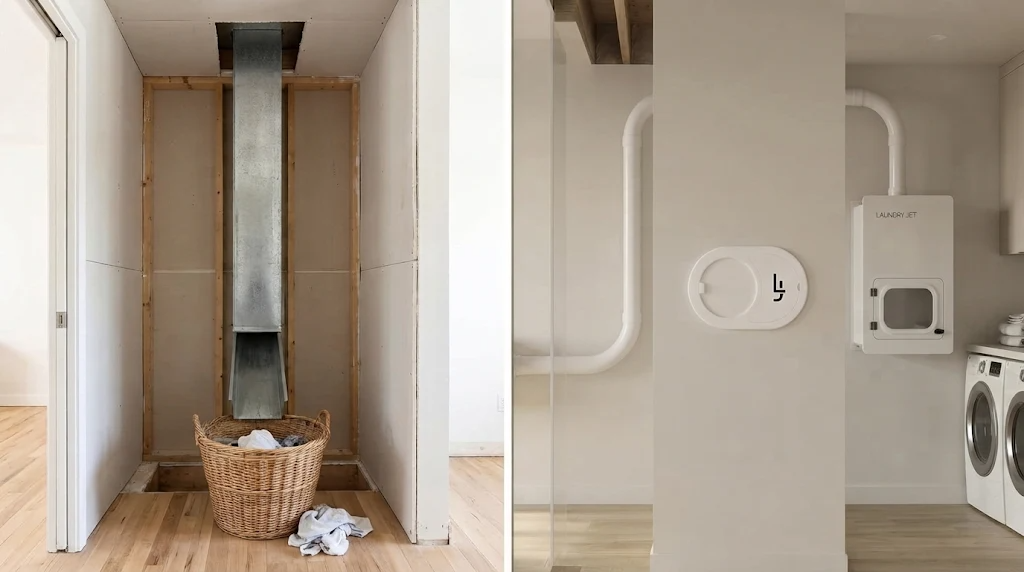
A laundry chute kit can make moving dirty clothes downstairs more convenient, but it is not the only option for a modern home. A traditional kit typically creates a gravity-fed drop from an upper floor, while a vacuum-powered laundry chute uses airflow to move suitable laundry through a planned pipe network. Both can reduce trips with laundry baskets, yet they differ in layout flexibility, installation, ongoing operation, and the types of homes they suit.
If you are comparing a DIY laundry chute, a conventional home laundry chute, and a powered solution such as Laundry Jet, this guide will help you understand what you are actually buying, what to ask an installer, and which option makes sense for your property. The better choice depends on the route your laundry needs to travel—not simply whether one product sounds more advanced.
Table of Contents
1. What Is a Laundry Chute Kit?
2. What Is a Vacuum-Powered Laundry Chute System?
3. Key Differences Between a Laundry Chute Kit and a Vacuum-Powered System
4. What Are the Advantages of a Traditional Laundry Chute Kit?
5. What Are the Benefits of a Vacuum-Powered Laundry Chute?
6. Which System Is Easier to Install in an Existing Home?
7. DIY Laundry Chute Kit vs. Professional Powered Installation
8. Laundry Chute Kit Cost vs. Vacuum Laundry System Cost
9. How Do Laundry Chute Dimensions and Routing Differ?
10. Which Is Better for a One-Story or Two-Story House?
11. What About Safety, Building Codes, and Maintenance?
12. How Do Laundry Jet Express, Swift, and Plus Vuelo Compare?
13. Which Option Is Better? Three Practical Home Scenarios
14. What Should You Check Before Buying a Laundry Chute System?
15. Frequently Asked Questions
16. Final Thoughts: Which Laundry Chute Is Right for Your Home?
1. What Is a Laundry Chute Kit?
A laundry chute kit generally refers to a set of parts intended to create a passage for dirty clothes to move from one part of a building to another. Most homeowner-focused kits are associated with gravity laundry chutes: items enter through a door or opening upstairs and fall into a lower-level collection area.
Kits vary significantly. Some may supply an inlet door or trim, while others include a liner or additional components. Do not assume that a product labeled a *laundry chute kit* contains all the materials, framing work, fire-rated components, or labor required for a finished installation.
How Does a Gravity Laundry Chute Work?
A traditional chute relies on gravity. Dirty clothes are placed into an upstairs opening, pass through an enclosed vertical route, and arrive in a hamper or receiving space below. There is no powered motor pulling the clothes through the chute. The simplest layouts have a nearly vertical route with a receiving area underneath.
Is a Laundry Chute Kit the Same as a Laundry Jet System?
No. A gravity-fed kit is not interchangeable with a powered laundry vacuum system. Laundry Jet’s vacuum-powered laundry chute system uses a motorized unit, purpose-specified piping, compatible laundry ports, and controls. The correct components and installation steps depend on the chosen model.
2. What Is a Vacuum-Powered Laundry Chute System?
A vacuum-powered laundry chute uses airflow generated by a powered unit to move suitable clothing and household linens from an access port toward a receiving unit, often located in the laundry room. Rather than relying only on a straight downward drop, the pipe network can be designed with appropriate horizontal runs and changes of direction.
In a Laundry Jet installation, the homeowner uses a compatible manual or automatic laundry port. The system transports items through the pipe network, and the receiving unit collects them at the destination. This is why an air-powered laundry chute can be considered for single-story houses as well as multi-level homes.
A powered system needs electricity and manufacturer-approved equipment. It is not simply a household central vacuum hose repurposed as a laundry chute. Visit the Laundry Jet homepage for an overview of how the technology operates.
3. Key Differences Between a Laundry Chute Kit and a Vacuum-Powered System
The comparison below summarizes the most useful decision points for US homeowners. Actual results vary by kit, manufacturer, home construction, model, and installation route.
| Decision factor | Traditional gravity laundry chute kit | Vacuum-powered laundry chute system |
| How it moves laundry | Clothes drop downward using gravity | Motor-driven airflow transports clothes through pipes |
| Typical route | Requires a workable downward passage | Can include suitable horizontal and vertical runs |
| Single-story home | Limited for same-floor transport | Possible with a properly planned layout |
| Multiple inlet points | Depends on shaft layout and design | Available depending on powered model and port count |
| Electricity to transport | Not needed for chute operation | Needed when the powered unit runs |
| Installation needs | Building openings, safe enclosure and receiving point | Unit, approved pipes/fittings, ports, wiring and planned routing |
| Optional clean return | Not a standard gravity-kit feature | Available on compatible Laundry Jet configurations |
| Best fit | Simple downward drop with a safe route | Flexible room-to-room or multi-port transport |
A conventional chute is a sensible solution when you already have a practical downward path. A powered laundry chute system becomes more attractive when you need laundry access in several rooms, on one level, or away from a straight vertical shaft.
4. What Are the Advantages of a Traditional Laundry Chute Kit?
A Straightforward, Non-Powered Operating Principle
A gravity chute moves laundry without a motor. When an appropriately designed vertical route exists, its basic operating method is easy to understand and does not use electricity to transport clothing.
A Practical Fit for Certain Multi-Story Floor Plans
A two-story house with bedrooms directly above a suitable laundry collection area may be a good candidate. A homeowner planning a simple vertical drop may not need an elaborate powered transport network.
Fewer Powered Components
Because the chute itself has no blower unit, there is no motor or electrical control system dedicated to moving laundry. This does not eliminate the need for cleaning, access, or a safe, code-compliant installation.
Why It May Not Be the Best Choice
A laundry chute kit can be difficult to accommodate when the laundry room is not below the source, when the path crosses structural or mechanical elements, or when local rules require additional construction. Clothes can also snag in poorly designed passages. The simplicity of gravity should not be confused with permission to cut through walls or floors without review.
5. What Are the Benefits of a Vacuum-Powered Laundry Chute?
More Freedom in Choosing Laundry Port Locations
With appropriate routing, a powered laundry chute can connect locations such as bedrooms, closets, or hallways to a central receiving area. A homeowner does not necessarily need to position the laundry room immediately below each inlet.
Suitable for One-Story as Well as Multi-Level Homes
For a house with its laundry room across the hallway or at the opposite end of the same floor, gravity alone cannot transport clothes sideways. A powered system can address this situation through a planned pipe network.
Multiple Collection Points
Depending on the Laundry Jet model, several compatible laundry ports can be connected to a receiving unit. This can help families avoid collecting full baskets in multiple bedrooms. See the Express Vuelo, Swift Vuelo, and Plus Vuelo models for manufacturer-stated port capacities.
Optional Clean-Laundry Return
A compatible Laundry Jet Return Unit may be added using a separate return-pipe arrangement, allowing clean, dry clothes to travel to a selected room. This is not a standard feature of an ordinary gravity-only chute kit.
What Are the Trade-Offs?
A vacuum-powered solution requires an appliance, a correctly planned pipe route, power, controls, and suitable access for servicing. It introduces equipment and installation costs that a simple gravity passage may not have. Its benefit comes from greater routing and usage flexibility, not from being automatically the best option in every property.
6. Which System Is Easier to Install in an Existing Home?
The answer depends on what is already behind the walls, above the ceiling, and below the floor. Neither option should be assumed to be an easy retrofit without looking at the actual building.
Installing a Gravity Laundry Chute in an Existing House
A gravity chute needs a suitable downward passage and receiving area. An installer may need to examine floor framing, joists, utilities, existing ductwork, access, and fire separation before proposing an opening. The path must also be suitable for the size and type of laundry being transported.
Installing a Powered Laundry Chute in an Existing House
A vacuum laundry chute needs space for the powered unit and a routed pipe network, but it does not require every source location to be directly above the laundry room. Closets, attics, chases, and other appropriate spaces may present routing options, subject to the home’s actual construction and model limits.
Planning a New-Build Installation
During new construction, both types can be considered while the home is being designed. A traditional chute may be planned around a vertical shaft, while a powered system requires coordination for the unit location, pipe routing, laundry ports, and electrical/control provisions.
For model-specific installation videos, components, and guides, use the official Laundry Jet Installation Information. That resource should be treated as the technical reference—not a general blog comparison.
7. DIY Laundry Chute Kit vs. Professional Powered Installation
The term DIY laundry chute often appears in searches about building a gravity-fed passage. Some projects may look straightforward online, but actual construction can involve hidden services, changes to wall or floor assemblies, and local safety requirements.
A packaged kit does not remove the need to check structural conditions or applicable code provisions. A contractor or local building official can advise whether a proposed gravity chute is feasible and what measures the installation may require.
A Laundry Jet system may be installed by qualified contractors or suitably experienced installers following the correct model-specific guidance. Whether homeowner installation is appropriate depends on the installation requirements, local rules, and the person’s qualifications. Do not use instructions for a gravity chute kit as a substitute for a powered-system manual.
Planning a retrofit? Start by checking the official installation guides and then request a project-specific Laundry Jet quote.
8. Laundry Chute Kit Cost vs. Vacuum Laundry System Cost
It is tempting to compare a low advertised kit price with the price of a complete powered system, but those figures may not represent equivalent scopes of work.
What Can Affect the Cost of a Gravity Chute?
A laundry chute kit may cover only part of the finished project. Total cost can depend on the inlet door, chute liner, enclosure, framing or finish work, receiving area, professional labor, and any required safety or code measures.
What Can Affect the Cost of a Vacuum-Powered System?
A powered laundry chute system may involve the chosen appliance, number of laundry ports, routing distance and complexity, pipe and fittings, electrical/control requirements, installation labor, and any optional clean-laundry return features.
Is One Option Always Cheaper?
No reliable universal price comparison is possible without the home layout and a complete installation scope. A basic gravity kit may have fewer purchased components, but construction constraints can change the total project cost. A powered system has more equipment, yet may offer capabilities that a traditional drop cannot provide.
Laundry Jet uses a personalized quote process rather than a single public installed price. To compare realistic options, request a Laundry Jet quote and ask what is included, what installation services are separate, and which site conditions may affect the project.
9. How Do Laundry Chute Dimensions and Routing Differ?
Traditional Laundry Chute Dimensions
A traditional chute opening and passage must be planned around the intended items, available space, and applicable requirements. The necessary dimensions are not the same for every property or every kit. A narrow or poorly routed chute can snag clothes, while an unsuitable opening or location may create other concerns.
Powered Laundry Chute Pipe Size
Laundry Jet’s current US installation resources specify 6-inch SDR35 PVC pipe and compatible fittings for its residential transport network. Pipe outside diameter, bends, clearances, and access requirements matter when designing a real route. Follow the relevant model’s installation guide rather than substituting generic household ventilation ducting.
Port Placement and Routing
A laundry chute in a house should be convenient to use without obstructing normal activity. Bedrooms, closets, and hallways are common locations to evaluate, but the correct placement depends on the route and compatible port design.
For examples of manual and automatic entries, review the Lift Port, Slide Port, and iTap Port information. Not every port is compatible with every Laundry Jet model.
10. Which Is Better for a One-Story or Two-Story House?
One-Story Homes
For a single-story property, a traditional gravity chute usually does not solve the problem of moving clothes horizontally to a remote laundry room. A vacuum-powered laundry chute is generally the more relevant option when the homeowner wants to move laundry between rooms on the same level and a compliant installation route is available.
Two-Story Homes
If the upstairs clothes drop can terminate directly in a suitable laundry collection area below, a traditional chute may work well. If the laundry room sits elsewhere or several rooms need their own access points, a powered system may offer a more useful layout.
Larger or Multi-Level Homes
Homes with many bedrooms or more complex routes may benefit from multiple powered access points, subject to the chosen unit’s limits. However, greater capacity and additional ports should be justified by actual household use and a feasible pipe plan.
11. What About Safety, Building Codes, and Maintenance?
Laundry chute installation is not only a convenience decision. Any proposed opening or pipe route must be reviewed for structural, fire-safety, electrical, and other local requirements as applicable.
A gravity-fed chute can create a passage between building levels, so the enclosure and openings require particular attention. The requirements for a residential laundry chute can differ from those for a hotel or commercial linen chute. Do not assume that a retail kit automatically complies with local rules.
A powered system should be used only with appropriate laundry items and maintained according to the manufacturer’s instructions. Keep service points accessible; do not send hard, sharp, or prohibited items through the transport network. Both systems may need occasional inspection or clearing if clothing becomes lodged.
The appropriate approach is to consult the local authority having jurisdiction and a qualified installer before changing walls, floors, or protective building assemblies. For Laundry Jet-specific operating questions, read the Laundry Jet FAQs.
12. How Do Laundry Jet Express, Swift, and Plus Vuelo Compare?
When the homeowner chooses a powered system, the next question is how many access points the layout needs and which port features matter. Laundry Jet’s current US Vuelo product pages describe the following configurations.
| Model | Maximum ports | Port/control family | Typical planning use |
| Express Vuelo | 2 | Low-voltage manual Lift / Slide | Smaller systems |
| Swift Vuelo | 4 | Cat5/6 compatible Lift, Slide, iTap | Multi-room homes |
| Plus Vuelo | 8 | Cat5/6 compatible Lift, Slide, iTap | Larger / custom layouts |
Express Vuelo: For Smaller Configurations
The Laundry Jet Express Vuelo is an entry-level unit with up to two port locations. It is designed for compatible low-voltage manual Lift and Slide ports. If you’re comparing it with a kit, remember that Express is still a complete powered laundry transport appliance rather than a gravity chute liner.
Swift Vuelo: For Additional Laundry Access Points
The Laundry Jet Swift Vuelo supports up to four ports and compatible Cat5/6-connected port styles, including manual options and the iTap automatic port. It may suit families who want access from several locations.
Plus Vuelo: For More Complex Home Layouts
The Laundry Jet Plus Vuelo supports up to eight port locations and is designed for installation within custom laundry-room cabinetry. It is the higher-capacity choice in the current Vuelo range.
Model selection should follow a real layout and the latest product documentation. The listed port capacities reflect the individual product pages; any conflicting FAQ wording should be resolved by the technical team before an installation is specified.
13. Which Option Is Better? Three Practical Home Scenarios
Scenario A: Bedrooms Directly Above a Basement Laundry Room
If the home has a safe, suitable vertical route ending near the laundry collection area, a traditional laundry chute kit may be an appropriate option. Compare the total finished installation requirements—not only the kit’s retail price.
Scenario B: Bedrooms and Laundry Room on the Same Floor
When laundry needs to travel horizontally, a gravity chute alone will not provide the intended transport. A properly planned vacuum-powered laundry chute system is the more suitable category to investigate.
Scenario C: A Home With Several Bedrooms and Different Floors
Where a family wants multiple entry points, varied routes, and potentially a clean-laundry return, a powered system may be more useful. The exact Laundry Jet model depends on the number of ports, distances, placement, and installation feasibility.
The goal is not to declare one technology universally better. It is to select the right transport method for the route and lifestyle.
14. What Should You Check Before Buying a Laundry Chute System?
Use this simple decision checklist before choosing a laundry chute kit or a powered alternative.
• Where does laundry start, and where must it arrive? Confirm the collection rooms and receiving location.
• Is there a clear downward route? A gravity chute depends on it; horizontal transport suggests a powered option.
• How many entry points would be useful? One shared port may be enough, or multiple rooms may need access.
• What is behind the walls and floors? Check framing, utilities, clearances, and access with an installer.
• What does the total project include? Compare materials, labor, finishing work, controls, and maintenance access.
• Do local building rules affect the plan? Confirm requirements for your specific home and jurisdiction.
• Would a return system add value? Consider the optional clean-laundry return if available for the chosen configuration.
• Do you have the exact installation guide? Use the correct manufacturer’s current document for the selected model.
• Ready to explore a powered option? Review the Laundry Jet product range and request a personalized quote based on your home’s layout.
15. Frequently Asked Questions
A laundry chute kit is a collection of components used to build a laundry transport passage, most commonly a gravity-fed chute between building levels. Kit contents vary, so you should check exactly which parts are included before ordering.
A traditional chute moves clothing downward using gravity. A vacuum laundry chute uses motor-driven airflow and a connected pipe network, making correctly planned horizontal or multi-directional routes possible.
A simple gravity kit may contain fewer pieces of equipment, but its price does not necessarily represent the cost of a finished, code-compliant installation. Laundry Jet’s total cost depends on the model and project requirements, so a direct comparison requires quotes for equivalent scopes of work.
DIY feasibility depends on the kit, construction work, and local requirements. Changes to structural, fire-rated, electrical, or other assemblies may require qualified professionals and permits. Never cut into floors or walls without confirming what’s inside.
Yes. A correctly designed air-powered laundry chute can move laundry through horizontal pipe runs, so a one-story home can be suitable even without an upstairs collection point.
Laundry Jet is a purpose-designed laundry transport system with its own powered unit and approved components. Do not assume a home’s central vacuum pipes or motor can be substituted for the specified Laundry Jet equipment.
The current Vuelo product pages list up to two ports for Express Vuelo, four for Swift Vuelo, and eight for Plus Vuelo. Actual design limits and port compatibility should be confirmed from the appropriate installation documentation.
Laundry Jet’s residential US installation information specifies 6-inch SDR35 PVC pipe and suitable fittings. The planned path, available clearances, and model-specific requirements determine whether it can be installed in a particular home.
A compatible Laundry Jet Return Unit can transport clean, dry clothing through a separately planned return arrangement. It is an optional configuration and should not be assumed to be included in every system quote.
A gravity laundry chute kit may be a good fit when a safe vertical drop already matches the floor plan and the household only needs simple downward transport. A vacuum-powered laundry chute may be the better fit when the laundry room is across the home, the house has one level, or multiple laundry access points are needed.
16. Final Thoughts: Which Laundry Chute Is Right for Your Home?
The choice between a laundry chute kit and a vacuum-powered laundry chute system comes down to what the home needs the laundry to do. A traditional gravity chute is a useful, straightforward solution for the right vertical layout. A powered system adds routing flexibility, multiple port options, and possible clean-laundry return features—along with equipment and installation considerations.
For US homeowners, the most useful next step is to map the desired laundry route, identify installation constraints, and compare complete solutions rather than isolated component prices. A system that fits your home’s construction and everyday routine is more valuable than a feature list alone. If a powered solution fits your plans, explore Laundry Jet’s vacuum-powered laundry chute systems, consult the installation guides, or request a personalized quote for your property’s requirements.