

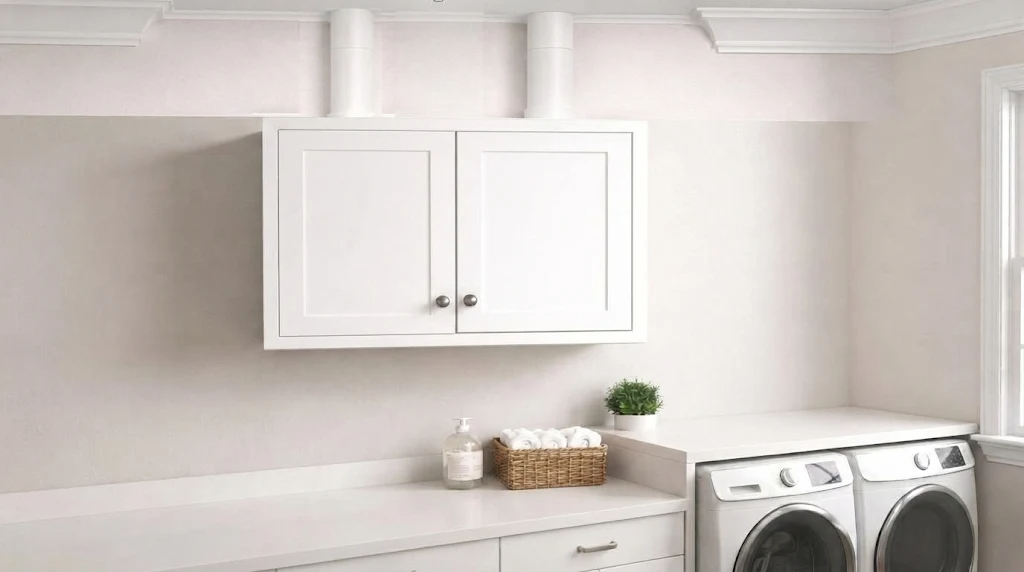
The best laundry chute system for your home depends on your floor plan, the number of laundry collection points you want, and how you prefer to use them. For a compact layout with one or two manual ports, Laundry Jet Express Vuelo may be enough. For a family home that needs more collection points or button-operated ports, Swift Vuelo offers greater flexibility. For a larger home with a more complex pipe network or a custom-designed laundry room, Plus Vuelo is the premium choice.
Choosing the biggest model is not automatically the smartest decision. A well-planned system puts ports where the household actually needs them, fits the available pipe route, and makes laundry collection easier every day. This guide compares the current 2026 Laundry Jet Vuelo models and shows how to choose a powered laundry chute without overbuying or overlooking important installation details.
Table of Contents
1. What Makes a Laundry Chute System Right for a Home?
2. Express vs. Swift vs. Plus Vuelo: Quick Comparison
3. When Is Express Vuelo the Best Choice?
4. When Is Swift Vuelo the Best Choice?
5. When Is Plus Vuelo the Best Choice?
6. How Many Laundry Ports Does Your Household Really Need?
7. Does a One-Story or Two-Story House Change the Best Model?
8. Manual Lift, Manual Slide or Automatic iTap: Which Port Is Better?
9. Should You Add a Clean-Laundry Return Unit?
10. Installation Considerations Before Choosing a Model
11. Is the Most Expensive Laundry Chute Model Always Better?
12. Five Questions to Ask Before Requesting a Laundry Jet Quote
13. Which Laundry Jet Model Should You Choose? Practical Scenarios
14. Frequently Asked Questions
Final Thoughts: Match the Model to Your Home, Not the Other Way Around
1. What Makes a Laundry Chute System Right for a Home?
A traditional laundry chute usually relies on gravity and a downward path. A vacuum-powered laundry chute uses airflow to move suitable clothing and household linens through a planned pipe route to the laundry room. That means a powered system can be considered for single-story houses, homes where the laundry room is across the floor, and multi-level properties with several collection points.
For homeowners, the most important question is not simply, “Which model is best?” It is, “Which model supports the way my family will use the system?” Start with the laundry room location, the rooms where laundry accumulates, and the number of ports that would genuinely save steps. Then compare those requirements with model capacity, port compatibility, installation space, and budget.
If you are still deciding between a conventional gravity chute and a powered system, compare those two approaches first. This article focuses specifically on choosing between Laundry Jet’s three current Vuelo models.
2. Express vs. Swift vs. Plus Vuelo: Quick Comparison
| Model | Available ports | Compatible port types | Mounting | Max published route |
| Express Vuelo | Up to 2 | Lift LV / Slide LV (manual) | Wall or cabinet | 150 ft |
| Swift Vuelo | Up to 4 | Lift / Slide / iTap (Cat 5/6) | Wall mounted | 200 ft |
| Plus Vuelo | Up to 8 | Lift / iSlide / iTap (Cat 5/6) | Inside custom cabinetry | 200 ft |
All three models use powered airflow to move laundry to a receiving unit and are listed as compatible with an optional Laundry Jet Return Unit. Their main differences are how many collection ports they support, which ports and controls they use, and how the units are intended to fit into the laundry room.
Important: The distances shown above are published model limits, not a promise that every home can use the full distance. The number of bends, route layout, installation conditions, and technical instructions must be confirmed before choosing equipment.
3. When Is Express Vuelo the Best Choice?
The Laundry Jet Express Vuelo is the entry-level model in the current range. The manufacturer describes it as a wall- or cabinet-mounted system with up to two available port locations. It works with the Lift LV and Slide LV manual port versions rather than the automatic iTap port.
A good fit for a focused, smaller layout
Imagine a small two-bedroom home where family members can use one shared hallway port, or where a homeowner wants a port in a bedroom and another at a convenient nearby location. If the proposed route and port count fit the published specifications, Express can deliver the core benefit of powered laundry transport without selecting a higher-capacity unit unnecessarily.
Why manual ports can be perfectly practical
Some households do not need an automatic closing port. A manual Lift or Slide port still gives the user a convenient entry point for moving laundry into the system. The key is to choose the correct low-voltage (LV) version for Express, not a visually similar Cat 5/6 port intended for another model.
When to consider upgrading
Express may be too limited if you want collection points in several bedrooms, bathrooms, and dressing areas; if the route requires a longer or more demanding configuration; or if you specifically want the button-operated iTap experience. Its official product page lists a 150-foot maximum distance from the furthest port; the proposed layout still needs technical review.
Best-fit takeaway: Choose Express when a simple two-port plan meets your actual household needs and manual ports are acceptable.
4. When Is Swift Vuelo the Best Choice?
The Laundry Jet Swift Vuelo is the mid-range, wall-mounted option. It supports up to four ports and accepts compatible Cat 5/6-connected manual Lift and Slide ports as well as the iTap automatic port. The manufacturer lists a maximum distance of 200 feet from the furthest port, subject to installation requirements.
Well suited to many family routines
Consider a family home with three bedrooms upstairs and a shared laundry room downstairs. Rather than carrying baskets from each room, the family might place ports in the main bedroom, children’s hallway, and a dressing room. Four available port positions provide more flexibility than a two-port arrangement, without automatically moving to the largest model.
The value of automatic port options
Swift also suits homeowners who prefer an automatic, button-operated laundry port. On the current Vuelo range, the iTap port opens, activates the system, and closes automatically after the cycle. Manual ports remain an option, so a household can choose an appropriate combination rather than making every collection point identical.
A sensible middle ground, not a universal winner
Swift is a strong candidate when you need three or four collection points, more port choices, and a wall-mounted unit. It is not inherently the best model for a home that needs only one collection point, nor is it suitable if the planned project exceeds its specifications.
Best-fit takeaway: Swift often makes the most sense for a family home that values both multiple ports and flexibility in how those ports operate.
5. When Is Plus Vuelo the Best Choice?
The Laundry Jet Plus Vuelo is the top-of-range model. It is designed for installation inside custom cabinetry, supports up to eight port locations, and accepts compatible manual and automatic Cat 5/6-connected ports. The published maximum distance from the furthest port is 200 feet, although the complete routing plan must be assessed.
Designed for larger or more complex homes
In a large two-story or multi-level home, laundry may accumulate in several bedrooms, a primary suite, guest accommodation, and separate dressing areas. A higher port allowance makes it easier to design a system around those distinct locations without forcing every room to share a single opening.
Custom cabinetry matters
Plus is especially relevant when the laundry room is part of a carefully designed interior. Its cabinet-integrated configuration can support a clean, built-in appearance, but the cabinet must still provide the clearances, ventilation, access, and mounting arrangement required by the installation guide.
More capacity does not remove planning limits
Eight available ports should not be treated as permission to place an inlet anywhere in the house. Branch routing, pipe diameter, bends, electrical/control connections, access, and the final equipment location remain important. The best installation is the one the manufacturer and installer can approve for the actual building.
Best-fit takeaway: Plus is the strongest fit when a larger number of ports, custom cabinetry, and a more advanced design are genuine project requirements.
6. How Many Laundry Ports Does Your Household Really Need?
A laundry port is the point where you feed laundry into the system. Before selecting equipment, list the rooms in which dirty laundry regularly collects and decide whether each room needs its own opening.
One or two ports: keep the system simple
For a smaller household, one port in a shared hallway plus one in a frequently used bedroom may be enough. A well-placed shared port can be more useful than adding several openings only because the model supports them.
Three or four ports: plan around daily routines
Families often appreciate convenient access from multiple bedrooms or a dressing area. The right placement might reduce repeated trips with baskets, especially if the laundry room is on another floor.
Five to eight ports: map the whole property
Larger homes may benefit from several separate collection points, but only if each has a clear purpose. Ask whether some neighboring rooms can share a port. More openings increase routing and installation complexity and may affect the overall quote.
A practical exercise: Draw a floor plan and label each proposed port essential, useful, or optional. Ask for a quote based on essential locations first, then price additional ports as a separate decision.
7. Does a One-Story or Two-Story House Change the Best Model?
A powered system is not limited to the straight vertical drop associated with a gravity laundry chute. The main challenge is finding a feasible pipe route from each access point to the laundry room.
In a one-story home
A home with bedrooms at one end and the laundry room at the other may benefit from a powered pipe route. If only one or two collection points are needed, Express may be appropriate. If several bedrooms require access, Swift or Plus may become more practical. Single-story does not automatically mean entry-level.
In a two-story home
Look at where the upstairs bedrooms sit relative to the receiving unit. A traditional gravity chute might work if there is a safe, relatively direct downward path. A powered laundry chute system for a two-story house gives more options when the rooms and laundry area do not align, but model choice still comes down to port count and route feasibility.
In a larger multi-level home
The longest run, route complexity, and number of desired access points may matter more than square footage alone. Obtain a model-specific routing review rather than choosing Plus simply because the home is large.
8. Manual Lift, Manual Slide or Automatic iTap: Which Port Is Better?
The port is the part family members interact with most often. Selecting a port style can therefore be just as important as selecting the powered unit itself.
Lift ports: straightforward manual entry
The Lift Port is designed for manual opening and closing. Laundry Jet publishes both a low-voltage version for Express and a compatible Cat 5/6 version for Swift and Plus.
Slide ports: manual sliding access
The Slide Port opens by sliding its door. The manufacturer offers different connection versions, so the order must match the chosen Vuelo system.
iTap: automatic opening and closing
The iTap Port is the button-operated option for Swift and Plus Vuelo. It is not listed as compatible with Express Vuelo. This distinction matters when comparing quotes, because an automatic port preference can change which unit is suitable.
Selection tip: Pick the port style around who uses it, where it sits, and how the door will open in that space. Confirm the exact model-specific connector before purchase.
9. Should You Add a Clean-Laundry Return Unit?
Laundry Jet offers an optional Return Unit that can transport clean, dry laundry back toward a selected room after washing. The return setup uses a separate pipe route from the dirty-laundry collection network. It is available as a compatible option across the main Vuelo range.
This feature may appeal to a household that wants a more complete laundry workflow rather than simply collecting dirty clothes. But it adds another planning decision: where clean laundry should arrive, how the return route will run, and how the configuration affects available ports and the installation quote.
A Return Unit is not the same as adding a standard dirty-laundry inlet. Ask the installer to show both transport directions clearly on the floor plan.
10. Installation Considerations Before Choosing a Model
Even the right model can be a poor choice if it is planned without considering the building.
Confirm pipe space and routing
Laundry Jet’s current installation information specifies 6-inch SDR35 PVC piping and compatible fittings. This pipe cannot be assumed to fit inside every standard wall cavity. Routes may require an accessible closet, chase, attic, or other suitable space. Long bends, obstructions, and required access should be reviewed before any structural work.
Plan the receiving unit location
A wall-mounted unit needs adequate room for installation, opening, and servicing. Plus also needs a properly designed cabinet. Think about the everyday laundry workflow: where the clothes arrive, where they are sorted, and whether the equipment remains accessible.
Include electrical and control connections
The models do not use identical port wiring. Express uses the specified LV port arrangements; Swift and Plus use compatible Cat 5/6 ports. Follow the manufacturer’s approved documents and have qualified tradespeople review any electrical or structural work required.
Get approval before cutting or ordering
For a new build, coordinate the route before walls close. For a remodel, check framing, utilities, fire separation, access, and applicable local requirements. The official installation guides and videos are the technical reference; this article is a planning guide, not installation instructions.
11. Is the Most Expensive Laundry Chute Model Always Better?
No. The most suitable system is the one that meets the property’s requirements at an acceptable installed cost. Plus offers the highest published port capacity and custom-cabinet integration, but a home that needs only two manual ports may not benefit from that capacity. Likewise, a family set on automatic ports should not select Express solely because it is the entry-level model.
A realistic quote should account for the powered unit, type and number of ports, piping and fittings, installation labor, access work, optional Return Unit, and any cabinetry or finishing. Laundry Jet’s published product pages invite homeowners to request a quote rather than presenting one standard installed price that applies to every house.
Budget wisely: Ask for two configurations if you are undecided: one that covers your essential collection points and one that adds your preferred upgrades. This makes the difference in scope clearer without relying on guessed prices.
12. Five Questions to Ask Before Requesting a Laundry Jet Quote
- How many collection points do we genuinely need? Count essential ports first and optional extras second.
- Where will the laundry travel? Include the laundry room, likely pipe route, and any floor-level changes.
- Do we want manual or automatic ports? An iTap preference points toward Swift or Plus, not Express.
- Is this a new home or a retrofit? Existing walls, utilities, and access may shape the viable design.
- Do we need clean-laundry return? A separate return line can change the project scope and budget.
Bring these answers to the quotation process. A useful model recommendation is based on the actual floor plan, not only a general description of the house.
13. Which Laundry Jet Model Should You Choose? Practical Scenarios
| Home situation | Starting point | Why |
| Compact home; 1–2 manual collection points | Express Vuelo | A smaller number of collection locations |
| Family home; 3–4 collection points | Swift Vuelo | More inlets and optional iTap controls |
| Large residence; 5–8 distinct collection points | Plus Vuelo | Highest published port capacity |
| Two-story home with distant laundry room | Layout-dependent | Route feasibility matters more than floor count |
| Custom high-end laundry room | Plus Vuelo | Designed for custom cabinetry integration |
| Any home requiring clean-laundry return | Confirm model + return route | Optional Return Unit and separate pipe planning |
The scenarios are starting points rather than guarantees. Two homes with the same number of bedrooms can require completely different pipe networks. The installer should confirm the model, route, accessory compatibility, and final quote.
14. Frequently Asked Questions
For a smaller home with one or two collection points and a feasible route, Express Vuelo may be the most straightforward choice. Swift becomes more relevant if you want automatic iTap ports or additional collection points.
Swift supports more ports and compatible automatic port options, but that does not make it better for every home. Express can be appropriate when a simple manual-port layout meets the household’s needs.
The official product pages list up to two ports for Express Vuelo, up to four for Swift Vuelo, and up to eight for Plus Vuelo. Verify the final system design with Laundry Jet, especially where additional return features are involved.
Yes. A powered laundry chute can move laundry through an approved horizontal and vertical pipe route, so it is not restricted to a traditional gravity drop between floors.
Swift Vuelo and Plus Vuelo support compatible iTap automatic ports. Express Vuelo uses the specified manual Lift LV and Slide LV ports.
Potentially. Feasibility depends on the available pipe path, unit location, electrical/control connections, access, and local construction requirements. A professional assessment should come before demolition or equipment selection.
No. The number of useful ports, route complexity, and installation design matter more than square footage alone. A large home using only a few collection points may have different requirements from a smaller home seeking ports in every bedroom.
The manufacturer lists compatibility with its optional Return Unit across the Vuelo models. A dedicated return-pipe layout and compatible components must be planned separately.
Current Laundry Jet installation information specifies 6-inch SDR35 PVC pipe and suitable fittings. The final routing and fitting choices should follow the current guide for the selected model.
There is no reliable single installed price for every home. Cost depends on the model, number and type of ports, pipe routing, labor, optional return equipment, and any finished cabinetry. Request a project-specific Laundry Jet quote.
Final Thoughts: Match the Model to Your Home, Not the Other Way Around
The best laundry chute for your home is not necessarily the model with the most available ports. Express Vuelo makes sense when a simple layout and manual ports cover your needs. Swift Vuelo provides a practical step up for family homes seeking several collection points and automatic port options. Plus Vuelo is worth considering when the project calls for more ports, a complex layout, or integration into custom laundry-room cabinetry.
Start with a floor plan, identify essential collection points, and decide whether an optional clean-laundry return system belongs in the project. Then confirm the equipment and route with the manufacturer or qualified installer. The result should be a laundry system designed around daily living, rather than an oversized specification sheet.Ready to plan your system? Explore the Express Vuelo, Swift Vuelo, and Plus Vuelo models, review the installation resources, and request a quote based on your home layout.